
OpenAI brings GPT-4.5: smarter, more natural, more emotional
Have the article read aloud.
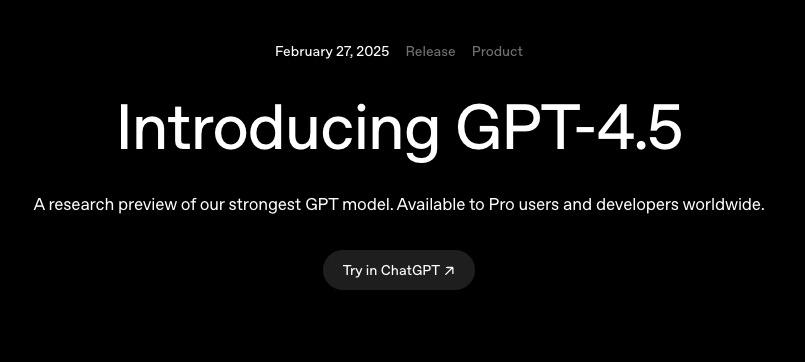
OpenAI has unveiled GPT-4.5 - the company's most powerful model to date. This new AI should not only provide more precise answers, but also react in a more emotionally intelligent way. It is now available for ChatGPT Pro users and developers in the API.
GPT-4.5 relies more heavily on unsupervised learning and should therefore recognize patterns even better and generate more creative solutions. According to OpenAI, the model reduces so-called hallucinations - i.e. false or invented information - and offers a more reliable knowledge base. Initial tests show that GPT-4.5 appears more natural in conversations and understands user queries more precisely.
In addition to the improvements in knowledge processing, GPT-4.5 scores with a sharpened sense of human communication. The model can capture more subtle meanings, respond better to emotions and respond more conversationally. Especially for creative tasks such as writing, design and programming, GPT-4.5 shows impressive capabilities.
The comparison with previous models is also exciting: According to OpenAI, GPT-4.5 outperforms its direct predecessor GPT-4o in several categories - from factual accuracy to emotional intelligence. At the same time, the question remains as to whether the model will remain in the API in the long term, as it is very computationally intensive and therefore more expensive.
If you want to see for yourself, you can try out GPT-4.5 in ChatGPT or use it in the OpenAI API. What do you think? Are these advances in AI really a big leap forward or just a small step? Write your opinion in the comments!
More details directly from OpenAI: Introducing GPT-4.5
BackDo you have a question or want to discuss the topic?
In the Community Hub for TYPO3 you can exchange ideas with other TYPO3 users. And if you don't want to miss any new articles: The TYPO3 Newsletter comes once a month, without spam.
![[Translate to English:] Wolfgang Wagner, TYPO3 Experte und Trainer](/fileadmin/_processed_/3/3/csm_DSCF2343_1600x900_9655ab17bc.jpg)
Hi, I'm Wolfgang.
I have been working with TYPO3 since 2006. Not in theory, but in real projects with real deadlines. I've probably had the problems you're having three times already.
At some point, I started putting my knowledge into video courses. Not because I like being in front of the camera, but because I kept hearing the same questions over and over again. There are now hundreds of videos. Every single one was the result of a specific question from a specific project.
What makes me different from a YouTube tutorial: I not only know the solution, but also the context. Why something works. When it doesn't work. And which mistakes you can avoid because I've already made them.
My participants use me as a sparring partner. Not in the sense of "call me anytime", but like this: You come to the live session with a specific problem, post your question in the community or watch the appropriate video. And get an answer that works because it comes from practical experience.
As a member of the TYPO3 Education & Certification Committee, I make sure that the certification exams are kept up to date. What is tested there flows directly into my courses.